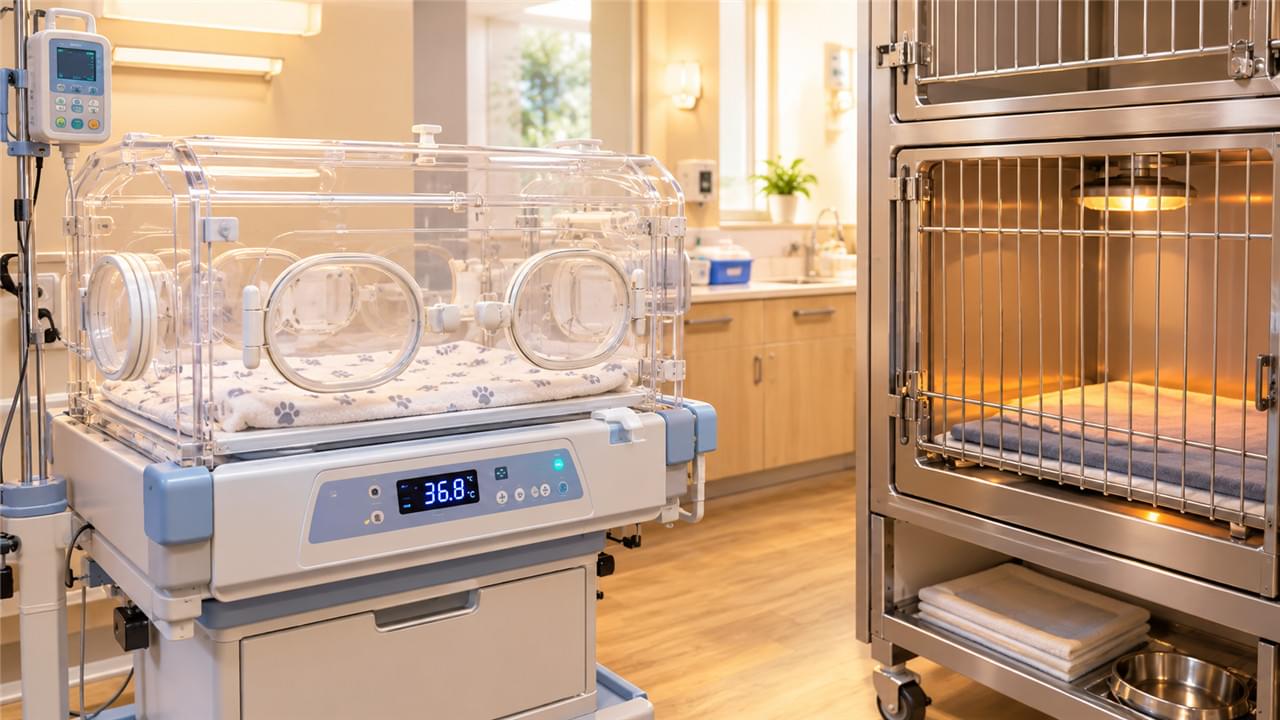
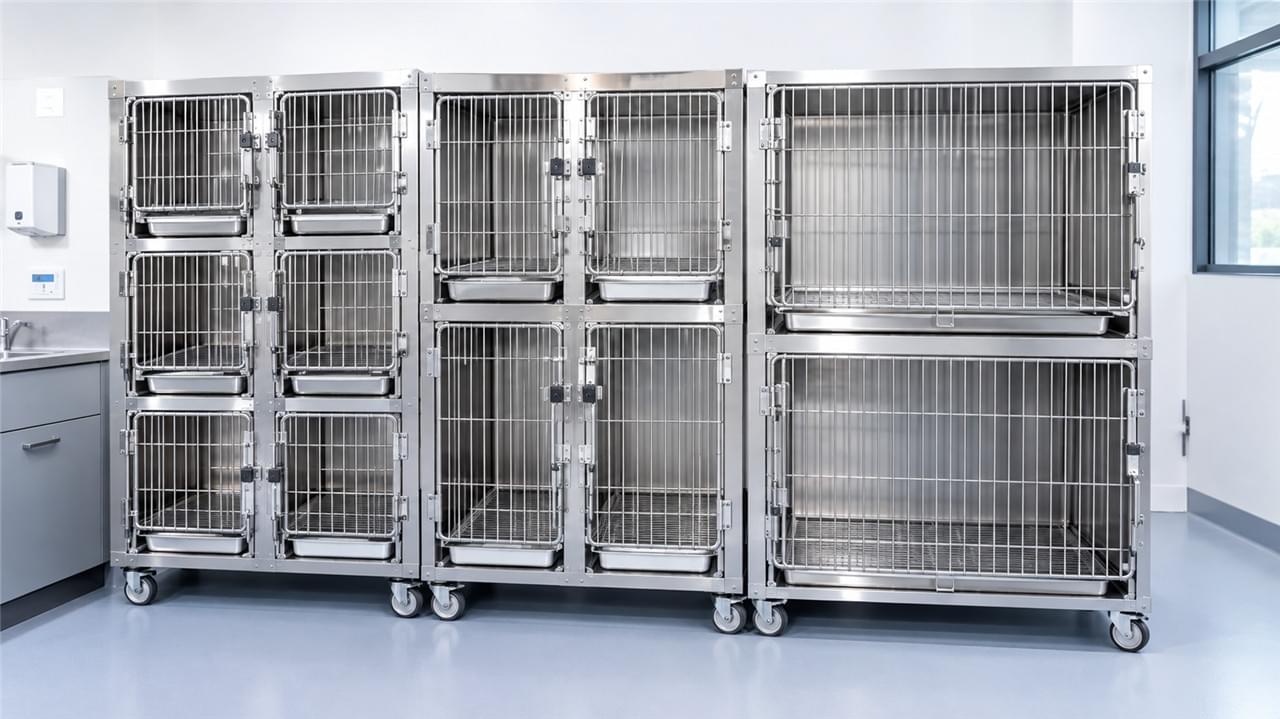
An anesthesia monitor and an ICU monitor both measure vital signs and display waveforms. They look similar. They’re often operated by the same clinical team. But they’re built for fundamentally different clinical environments — and comparing anesthesia monitoring vs ICU monitoring side by side reveals why using the wrong tool in the wrong context introduces patient safety risk.
Understanding anesthesia monitoring vs ICU monitoring differences helps clinic managers make smarter procurement decisions and helps clinicians know exactly what each system is designed to do. For the complete equipment context, see our Veterinary ICU & Critical Care Equipment: Complete Guide.
🧭 Core Design Philosophy: Different Clinical Problems
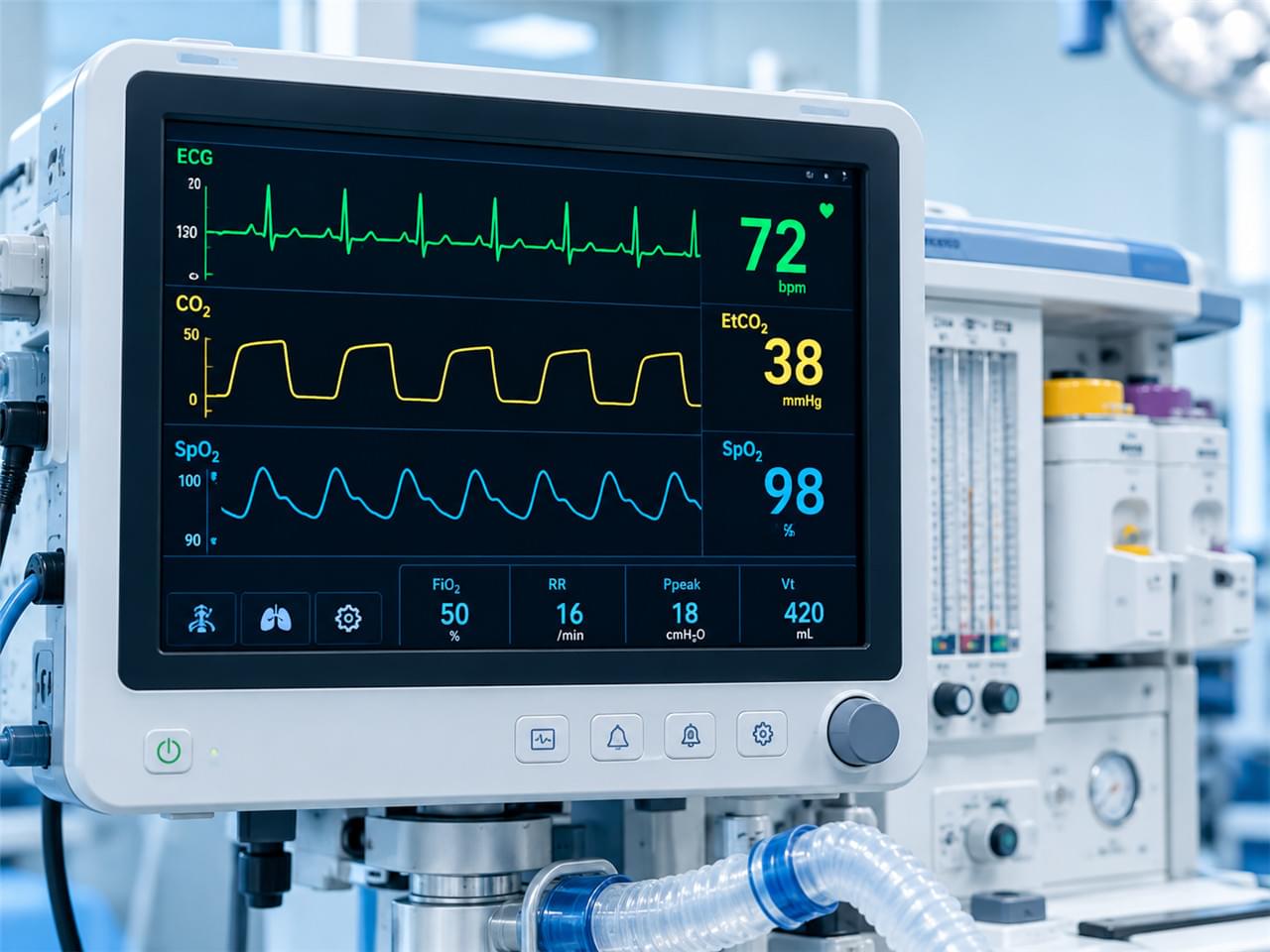
Anesthesia monitoring is built for the perioperative window — induction through recovery. Its design priority is integration with anesthetic delivery: most veterinary anesthesia monitor models are purpose-built to work alongside an anesthesia machine and include capnography (EtCO₂) as a standard parameter, because ventilatory assessment is the most critical safety check during general anesthesia.
ICU monitoring is built for extended continuous use — hours to days. Its priorities are reliability, alarm management, and multi-patient data aggregation. A veterinary ICU monitor is optimized for patients who are awake, lightly sedated, or mechanically ventilated independently of an anesthesia circuit.
📊 Parameter Comparison at a Glance
The spec sheet makes the anesthesia monitoring vs ICU monitoring split concrete — notice where “standard” and “optional” flip:
| Parameter | Anesthesia Monitor | ICU Monitor |
|---|---|---|
| ECG (continuous) | Standard | Standard |
| SpO₂ | Standard | Standard |
| NIBP | Standard | Standard |
| Temperature | Standard | Standard |
| EtCO₂ (capnography) | Standard (essential for intubated patients) | Optional/add-on (typically sidestream) |
| Invasive BP (IBP) | Optional | Often standard on mid-high tier |
| CVP | Rare | Optional on advanced tier |
| Network connectivity | Uncommon | Standard on mid-high tier |
| Battery duration | 1–4 hours (perioperative use) | 4–12 hours (extended ICU use) |
🔍 The 3 Key Differences: Anesthesia Monitoring vs ICU Monitoring
Key Difference 1: EtCO₂ — Where Anesthesia Monitoring vs ICU Monitoring Diverges Most
Capnography is the single most important safety monitor during general anesthesia. It confirms endotracheal tube placement, verifies ventilation, and detects circuit disconnection — all within seconds.
Anesthesia monitors universally integrate sidestream or mainstream EtCO₂ as standard, because anesthetized patients are always intubated or breathing through a tight-fitting mask. ICU patients are usually conscious and breathing spontaneously — EtCO₂ via nasal cannula sidestream is clinically useful but not a standard feature on every veterinary ICU monitor.
Practical implication: don’t buy an ICU monitor for use during anesthesia unless it includes integrated capnography. A monitor without EtCO₂ is inadequate for anesthesia regardless of how well it measures everything else — a rule reinforced in the AVMA anesthesia standards.
Key Difference 2: Alarm Management in Anesthesia Monitoring vs ICU Monitoring
Anesthesia monitors assume a one-to-one ratio: one anesthetist, one patient. They use simple threshold alarms designed to alert that person immediately.
ICU monitors assume one-to-many: one or two nurses watching multiple patients. That’s why anesthesia monitoring vs ICU monitoring diverges sharply on alarm design:
- 🚦 Tiered alarm levels (informational, warning, critical)
- ⏳ Alarm delay settings that suppress nuisance alarms from brief movement artifacts
- 📡 Centralized alarm relay to the nursing station
- 🗂️ Alarm history logging for documentation and review
Key Difference 3: Continuous Operation — Anesthesia Monitoring vs ICU Monitoring Duty Cycles
Anesthesia monitors run 30 minutes to 8 hours per procedure, then power down. Their components are engineered for that duty cycle — one more place where anesthesia monitoring vs ICU monitoring design assumptions simply don’t overlap.
ICU monitors run for days. The design differences that matter:
- Larger, longer-life internal batteries
- More robust screen brightness for continuous display
- Screen protection against repeated cleaning-solution exposure
- Software built for continuous data logging — trend graphs over 24+ hours
🔄 Buying Strategy: One Monitor or Two?
When One Monitor Serves Both: The Anesthesia Monitoring vs ICU Monitoring Overlap
For small practices with limited capital, some modern mid-range units are genuinely dual-purpose veterinary monitor candidates:
- They include EtCO₂ for anesthesia AND the battery life, connectivity, and alarm management appropriate for ICU use
- They can be cart-mounted — roll into the OR, then move to the ICU recovery area
The limitation: truly optimal ICU performance requires stationary installation with network connectivity and central station integration, which most mobile dual-purpose units can’t provide. If you’re weighing a dual-purpose purchase against a dedicated system, our breakdown of Vital Signs Monitoring Systems for Veterinary ICUs covers the ICU-side requirements in depth. And per the WSAVA global guidelines, monitoring adequacy should always be judged by the patient’s acuity — not by the number of devices you own.
❓ Frequently Asked Questions
Q: Can I use our anesthesia monitors in the ICU for post-surgical patients?
A: For the immediate recovery period (2–4 hours), yes — anesthesia monitors in a designated recovery area adjacent to the OR are a practical, widely used approach. For extended ICU monitoring (overnight, multi-day), the battery design, alarm management, and connectivity limitations make a veterinary anesthesia monitor suboptimal. In the anesthesia monitoring vs ICU monitoring decision, a dedicated ICU monitor is the correct solution for extended critical care.
Q: Is capnography necessary for ICU patients breathing spontaneously?
A: Not as a universal first-line requirement. But for patients at risk of hypoventilation — heavy sedation, opioid infusions, neurological disease, severe respiratory compromise — sidestream nasal capnography is a highly valuable addition. The ability to plug sidestream EtCO₂ into an ICU monitor as a module is worth prioritizing when you’re comparing anesthesia monitoring vs ICU monitoring equipment.
Q: What is the minimum monitoring equipment for a 4-cage ICU ward?
A: A pragmatic minimum: 2 dedicated ICU multi-parameter monitors (ECG, SpO₂, NIBP, temperature, IBP capability), 2 dual-purpose monitors that can serve both anesthesia and ICU recovery, and 1 portable spot-check monitor for transport and triage. That supports 4 simultaneous ICU patients with monitoring triaged by acuity.
✅ The Bottom Line
The whole anesthesia monitoring vs ICU monitoring debate collapses into one question: what duty cycle and what patient state is the machine built for? Buy capnography-first for the OR, alarm-and-uptime-first for the ICU — and if budget forces one device to do both, make sure capnography is on the spec sheet. A monitor that misses either requirement isn’t a compromise; it’s a gap.