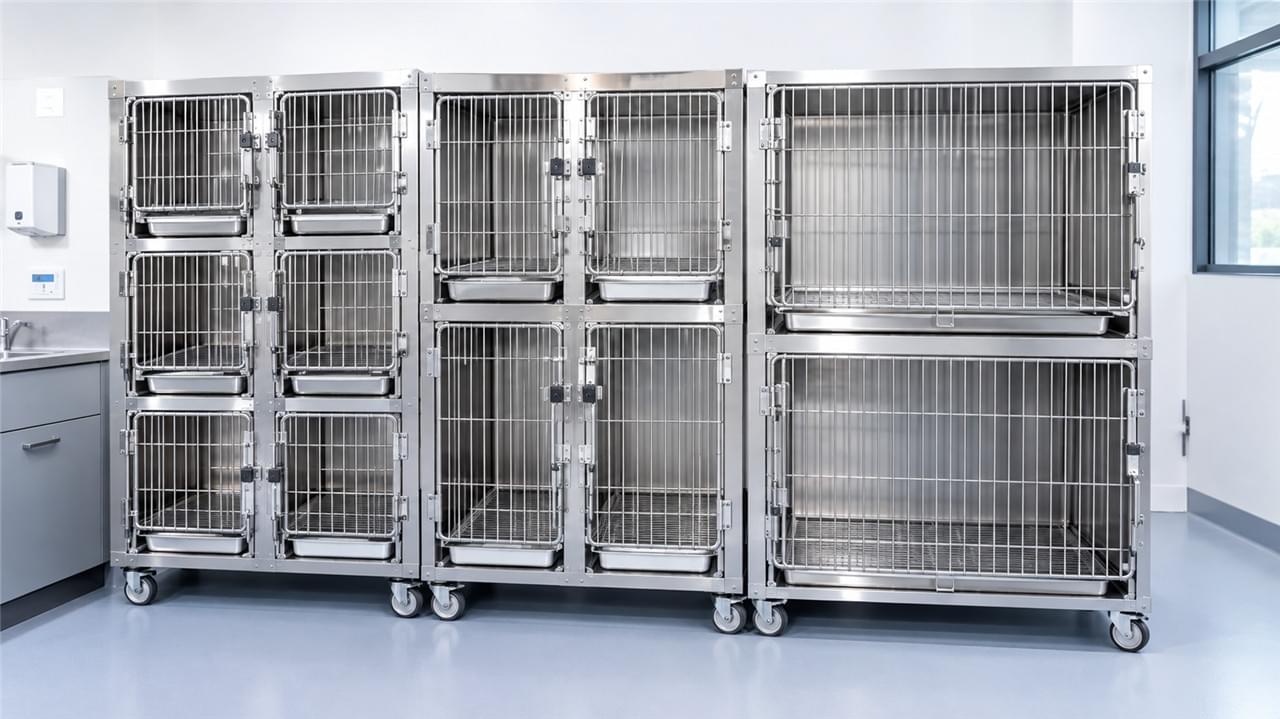
Veterinary cages are the most-used equipment in any hospital ward — every hospitalized patient spends hours to days in the unit you pick for them. That’s why knowing how to choose veterinary cages and hospital housing systems matters beyond the equipment budget: the decision directly affects patient welfare, infection control, nursing efficiency, and what clients conclude about your hospital’s quality the moment they walk past the ward.
This guide breaks the choice into five decisions, in the order they should be made. For the broader nursing and daily care context, see the Veterinary Nursing, Housing & Daily Care Equipment Guide.
📋 Step 1: Define Your Patient Population Requirements
Cage selection starts with patients, not products. Answer these before quoting a single unit:
- What weight range do you treat? (Cat-sized only, up to giant breed)
- Do you see neonates, exotics, or birds needing incubator-style housing?
- Do you manage infectious cases requiring physical isolation?
- What’s your typical hospitalization census at any one time?
- Do you have post-surgical patients needing ICU-level environmental control?
The answers set your size range, unit count, temperature-control integration, and isolation needs — everything downstream depends on them.
🛠️ Step 2: Choose the Right Material
Material choice is the decision with the longest consequences — the veterinary cages and hospital housing systems you install today will still be in service when the practice has changed hands twice. Three material options exist, and honestly, only one of them belongs in a clinical ward.
🥇 Stainless Steel: The Standard for Veterinary Cages
Stainless steel (304 or 316 grade) is the industry standard, and for good reasons:
- Fully compatible with hospital-grade disinfectants
- Extremely durable — 15–25 years of service in normal use
- Non-porous surface that doesn’t harbor microbial biofilm
- Temperature-resistant, so heated floor panels can be integrated
- A hygienic look that reassures every client who peers into the ward
316 grade (marine-grade) adds superior chloride corrosion resistance — worth specifying for coastal facilities or practices running high-chlorine disinfectant protocols. Stainless steel veterinary cages cost more upfront; they outlast every alternative by a decade or more.
🧴 High-Density Polyethylene (HDPE)
- Lighter than stainless, with good thermal insulation that helps maintain patient warmth
- Limitation: some aggressive disinfectants degrade the surface over time — verify chemical compatibility before purchase
- Cannot withstand autoclave temperatures, which limits decontamination options after severe contamination events
🚫 Powder-Coated Steel
Cheaper, yes — and not suitable for clinical housing. Powder coating chips over time, creating surface porosity that harbors bacteria. Avoid it for hospital wards entirely.
📐 Step 3: Select the Configuration and Size Range
🧩 Bank Configurations: Modular Cage Bank Options
Wall-mounted cage banks:
- Fixed position, space-efficient, professional appearance
- Less flexible if you reconfigure the ward later
Freestanding modular cage bank units:
- Reconfigurable and relocatable as needs change
- Need floor clearance behind and beneath for cleaning
Double-sided cage banks:
- Accessible from both sides of the ward — excellent for high-volume units
- Require a central aisle of minimum 1.5 m width
📏 Sizing the Right Veterinary Cages for Your Practice
A minimum complete configuration for a 2–3 vet general practice:
| Size Category | Internal Dimensions | Patient Weight |
|---|---|---|
| Small (cat/small dog) | 45×45×45 cm | ≤5 kg |
| Medium | 60×60×60 cm | 5–15 kg |
| Large | 90×75×75 cm | 15–35 kg |
| Extra large | 120×90×90 cm | 35–60 kg |
Baseline for a general practice: 2 small + 3 medium + 2 large + 1 extra large.
💧 Step 4: Evaluate Drainage and Cleaning Features
🕳️ Drainage: The Most Underspecified Feature in Veterinary Cages
Buyers obsess over door styles and forget drainage — then live with the consequences twice a day, every day:
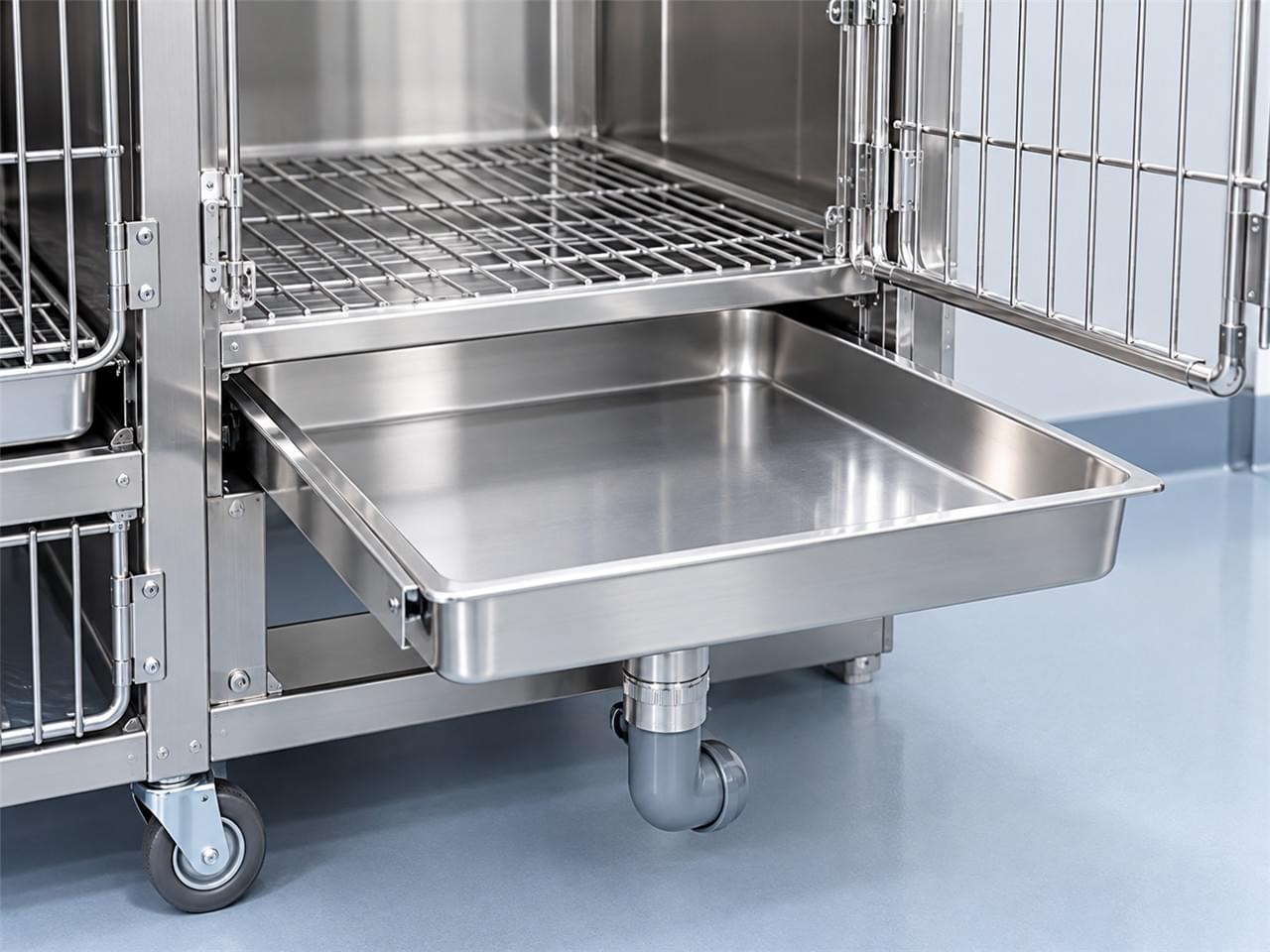
Individual cage drainage: each unit gets its own drain pan and outlet, so nothing cross-contaminates the neighboring cage.
Drain pan design:
- Stainless steel removable pans (not fixed welded) — cleanable, repairable, replaceable
- Minimum 15 mm depth to contain urine and wash-down water without overflow
- Smooth surfaces, no sharp corners — corners are where cleaning goes to die
Drain connections:
- Push-fit or screw-type connections to floor plumbing
- Anything requiring tools to disconnect is wrong for daily cleaning — tool-free is the spec
🚪 Step 5: Consider Locking, Access, and Door Design
Doors and locks are the parts of veterinary cages that get worked hardest — every shift, every patient — and where cheap hardware shows its age first.
Door styles:
- Horizontal sliding doors: space-efficient, can’t swing open accidentally
- Vertical guillotine doors: excellent for hands-free patient placement
- Full-front hinged doors: maximum procedure access; gull-wing configuration reduces patient distress at opening
Locking mechanisms:
- Double-lock latches for cats — cats learn to open single-point latches, and they will demonstrate this at 2 a.m.
- Recessed latch handles, so patients can’t injure themselves reaching through the cage front
❓ Frequently Asked Questions
🔢 How Many Cages Should a 3-Vet Small Animal Practice Have?
A 3-vet practice seeing 30–50 consultations daily should plan a minimum of 12–16 hospital cage units across all sizes, plus 2 isolation units. Census typically runs at 20–40% of capacity, but peaks — post-elective surgery days, respiratory virus season — can hit 70–80%. Size for the peak, not the average.
🎨 Are Powder-Coated Veterinary Cages Ever Acceptable?
No. Powder coating chips and crazes, creating a roughened surface that harbors bacteria and cannot be reliably disinfected to hospital standards. For permanent clinical housing, stainless steel veterinary cages are the only appropriate choice.
📦 Should I Buy Pre-Assembled or Flat-Pack Cage Systems?
Pre-assembled systems arrive ready to install and typically show better build quality at junctions and welds. Flat-pack systems ship internationally more easily, fit through standard doorways, and cost less at volume. For buyers outside the manufacturer’s home market, flat-pack with clear assembly documentation is usually the practical choice. Either way, remember that veterinary cages lead a hard life — inspect junction welds and latch samples before signing anything.
🎯 Key Takeaways
Choosing well comes down to sequence: define the patient population first, specify stainless steel for clinical durability, pick a modular cage bank layout that can grow with you, refuse to compromise on drainage, and match doors and locks to species behavior. Guidelines from the WSAVA animal welfare guidelines and AVMA hospital housing standards frame the welfare minimums — your patient census fills in the rest. For keeping those units warm, safe, and comfortable after installation, see Temperature Control and Comfort in Animal Wards. 🐾