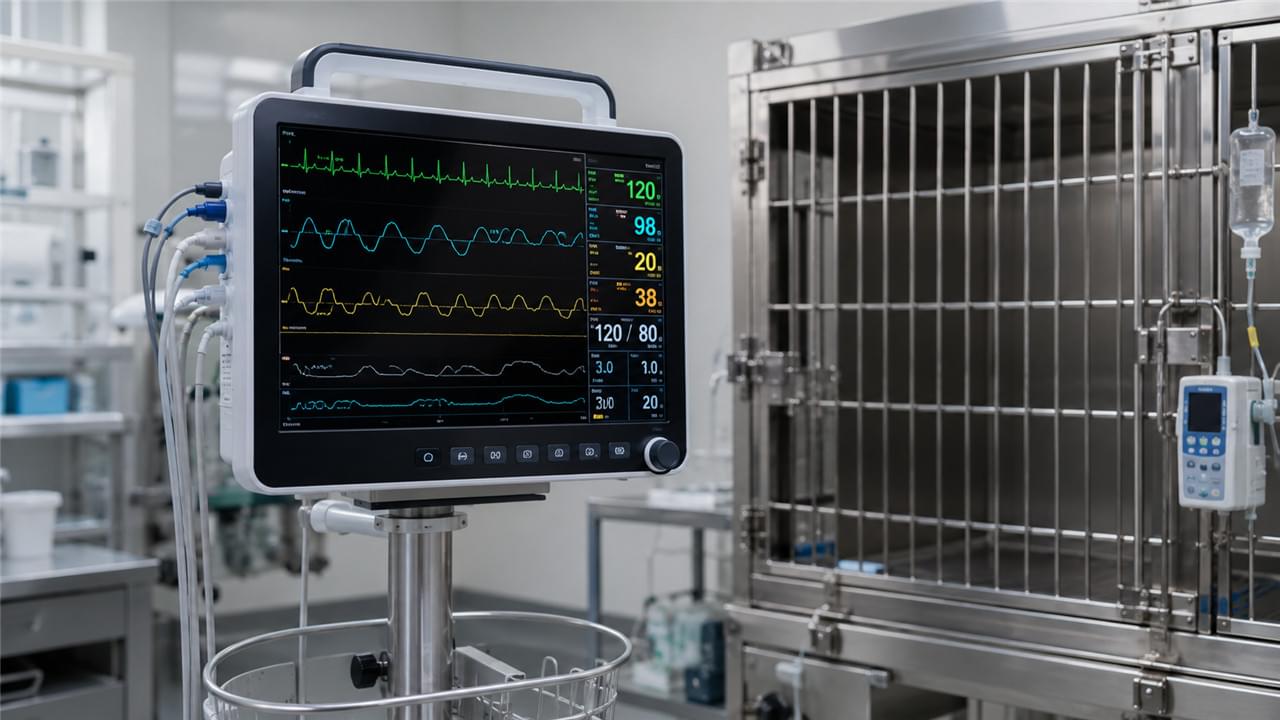
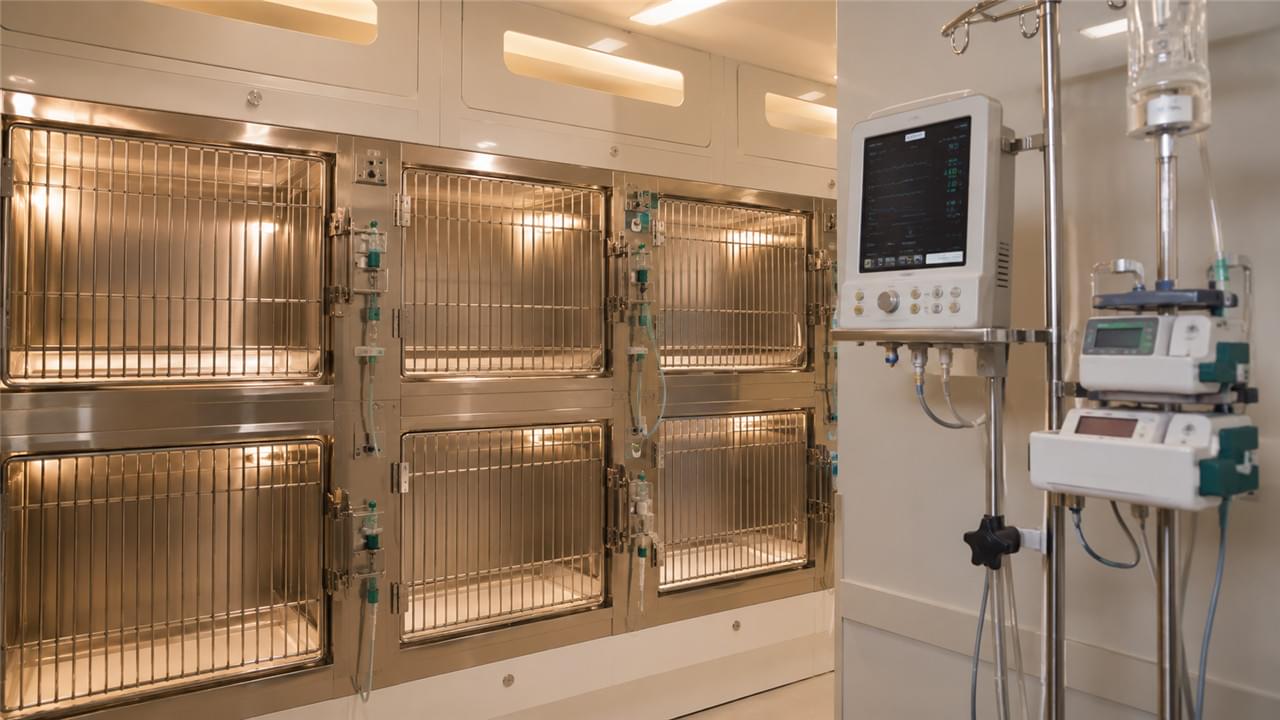
Continuous, reliable veterinary ICU vital signs monitoring is the most consequential piece of equipment in critical care — more than any single therapeutic device. A monitor that alarms within 30 seconds of a patient’s SpO₂ dropping to 75% enables intervention. A monitor that fails silently, or that staff ignore because of excessive false alarms, does not. The difference between those two scenarios is the entire argument for getting this category of equipment right.
This guide walks through the clinical and technical requirements of vital signs monitoring systems for veterinary ICUs — parameter selection, alarm management, and system integration — so you can build a monitoring setup that catches deterioration before it becomes catastrophic. For the complete ICU equipment framework, see Veterinary ICU & Critical Care Equipment: Complete Guide.
📊 The 5 Non-Negotiable ICU Monitoring Parameters
Why Veterinary ICU Vital Signs Monitoring Has 5 Essentials
Every veterinary ICU patient monitor must provide these five parameters:
1. Continuous ECG
- 3-lead minimum (I, II, III); 5-lead preferred for ischemia monitoring
- Display: continuous waveform with audible heart rate and alarm limits
- Clinical use: arrhythmia detection, rate monitoring, response to antiarrhythmic therapy
2. Pulse Oximetry (SpO₂)
- Probe types: lingual (intubated/anesthetized), rectal, digit, ear/toe
- Alarm threshold: SpO₂ ≤94% critical alarm; ≤90% severe alarm
- Limitation: SpO₂ is inaccurate in extreme vasoconstriction, severe anemia, and carboxyhemoglobinemia — blood gas correlation required in these cases
3. Non-Invasive Blood Pressure (NIBP)
- Oscillometric cycling: programmed every 5–15 minutes for conscious ICU patients
- Cuff size selection is critical — oversized cuffs underestimate blood pressure; undersized cuffs overestimate
- Mean arterial pressure (MAP) target: ≥65 mmHg for shock resuscitation endpoints
4. Core Temperature
- Rectal probe (continuous) or esophageal probe (intubated patients)
- Temperature alarm: <36.0°C (hypothermia alert) and >40.0°C (hyperthermia alert)
- Thermoregulation in ICU patients is an active management goal — not just a measured parameter
5. Capnography (EtCO₂)
- Mainstream or sidestream adapter for nasal oxygen cannula or intubated patients
- Normal EtCO₂: 35–45 mmHg; a rise indicates hypoventilation or CO₂ retention; a fall indicates hyperventilation or poor perfusion
A solid ICU multi-parameter patient monitor delivers all five — and lets you set per-patient alarm limits that actually fit the case in front of you.
🔬 Advanced ICU Monitoring: Invasive Parameters
Advanced Veterinary ICU Vital Signs Monitoring: Invasive Parameters
For hemodynamically unstable patients — shock, severe cardiac disease, post-major-surgery — non-invasive parameters aren’t enough. Advanced monitoring adds:
Invasive Arterial Blood Pressure (IBP)
- Requires arterial catheter placement (dorsal pedal or femoral artery, most common)
- Provides continuous beat-to-beat systolic, diastolic, and mean pressure
- Pulse pressure variation analysis assists fluid responsiveness assessment
- Compatible with most mid-range to advanced ICU monitors via standard pressure transducer sets
Central Venous Pressure (CVP)
- Measured via jugular or saphenous central venous catheter
- CVP trend over time is more clinically informative than single-point values
- Normal range in veterinary patients: 0–8 cmH₂O; elevated CVP suggests right heart failure or fluid overload
🖥️ Multi-Patient Monitoring: Central Station vs. Bedside
Centralized Veterinary ICU Vital Signs Monitoring: Station vs. Bedside
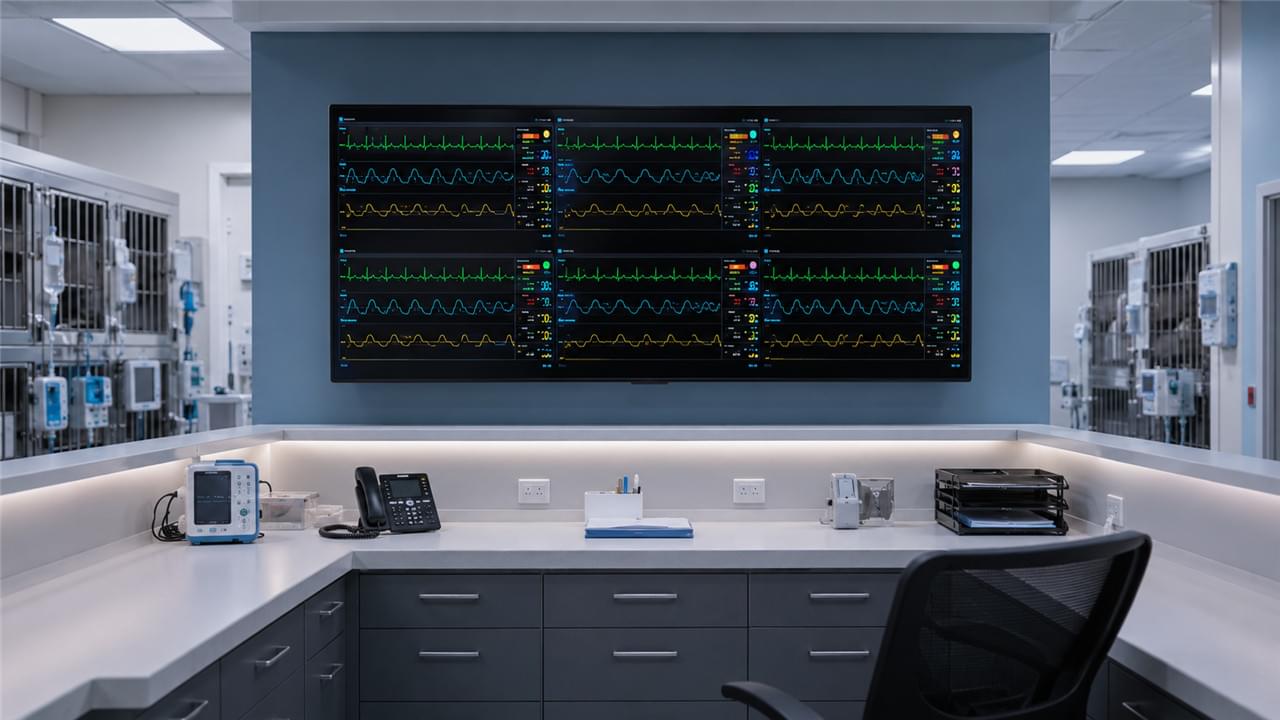
For ICU wards with multiple patients, a central monitoring station aggregates all patient waveforms and data on a single workstation visible from the nursing station.
Benefits:
- One nurse can observe all ICU patients simultaneously
- Alarm fatigue reduced by centralized alarm management (individual patient alarm limits customized)
- Trend data review accessible without entering each cage
Technical requirement: Monitors must support network output via standard medical telemetry protocols. Confirm network compatibility between bedside monitors and the central station before procurement — incompatible hardware is a procurement mistake you don’t want to discover post-installation.
🔔 Alarm Management: The Most Underestimated ICU Challenge
Alarm Fatigue: The Silent Failure of Veterinary ICU Vital Signs Monitoring
Alarm fatigue — the desensitization of staff to monitor alarms due to excessive false alarms — is one of the leading causes of adverse ICU outcomes in both human and veterinary medicine. The irony: a high-quality monitor with poor alarm configuration is functionally indistinguishable from a broken one.
Best practices to reduce alarm fatigue:
- Set alarm limits appropriate to the individual patient’s baseline, not default factory settings
- Disable non-critical alarms that are expected and clinically irrelevant (e.g., movement artifact on pulse ox in an awake animal)
- Review and update alarm limits at every patient reassessment
- Establish a written alarm response protocol: who responds, in what timeframe, to which alarm types
ICU alarm management veterinary practice requires real discipline — the default settings exist because they’re easy, not because they’re correct.
❓ Frequently Asked Questions
Q: Can veterinary practices use human ICU monitors in their critical care ward?
A: Many human patient monitors are used successfully in veterinary ICUs. Most parameter measurements (ECG, SpO₂, NIBP, temperature, capnography) work equivalently. Key considerations: NIBP algorithms may need validation against direct Doppler measurement for cats (oscillometric algorithms designed for humans may be less accurate in small feline patients), and species-specific reference range alarm defaults may need manual adjustment.
Q: How many monitors does a veterinary ICU ward need?
A: One monitor per ICU cage space intended for critical patients. A 6-cage ICU ward should have 6 monitors — or a minimum of 4 fully equipped monitors plus 2 portable step-down monitors for less critical patients. Don’t share monitors between active ICU patients — simultaneous deterioration in two patients with one monitor creates an unmanageable situation.
Q: What is the difference between a veterinary ICU monitor and a standard anesthesia monitor?
A: The functional overlap is significant — both measure the same core parameters. ICU monitors are designed for extended continuous use (days), with larger rechargeable batteries, more robust alarm management, and often network connectivity for central station integration. Anesthesia monitors are optimized for perioperative use (hours) with integrated EtCO₂ as standard. See our detailed comparison: Anesthesia Monitoring vs ICU Monitoring: Key Differences.
✅ Building a Monitoring Setup That Actually Works
The right monitor is the one your team trusts enough to respond to without hesitation. Build your veterinary ICU vital signs monitoring setup around the five non-negotiable parameters, layer in invasive monitoring for critical cases, centralize it for nursing efficiency, and tune the alarms to fit each patient — not the factory default. The WSAVA critical care monitoring guidelines and AVMA emergency and critical care standards are excellent references for benchmarking your configuration against international best practice.