Your nursing team is the operational backbone of the hospital — and their efficiency decides how many patients can be safely managed per shift, how fast post-surgical patients get attention, and how completely hospitalized animals are monitored. Veterinary nursing workflow is not a personality trait of your best nurse; it is the direct product of workflow optimization through nursing equipment design — removing unnecessary steps, cutting equipment access time, and letting nurses deliver maximum care within each shift.
For the broader equipment context, see the Veterinary Nursing, Housing & Daily Care Equipment Guide.
💸 The Hidden Cost of a Broken Veterinary Nursing Workflow
Before designing for efficiency, it helps to price the inefficiency — the hidden tax a poorly planned veterinary nursing workflow collects every single shift:
- 🚶 A nurse who walks to the drug room 20 times per shift loses 30–60 minutes of patient care time daily
- 📦 Equipment stored across multiple rooms forces repeated trips that delay procedures
- 🖥️ Documentation locked to a single desktop forces nurses to leave the patient to record observations
- 🧴 IV setup materials stored on a different floor delay IV initiation for every new admission
In a 3-nurse ward shift, these losses compound to 90+ minutes of forfeited direct patient care — time that should go to observation, enrichment, and monitoring. That’s the budget this article spends. 🕒
🏥 Fix 1: Build the Treatment Station as the Workflow Hub
🎯 Treatment Stations Built Around Veterinary Nursing Workflow
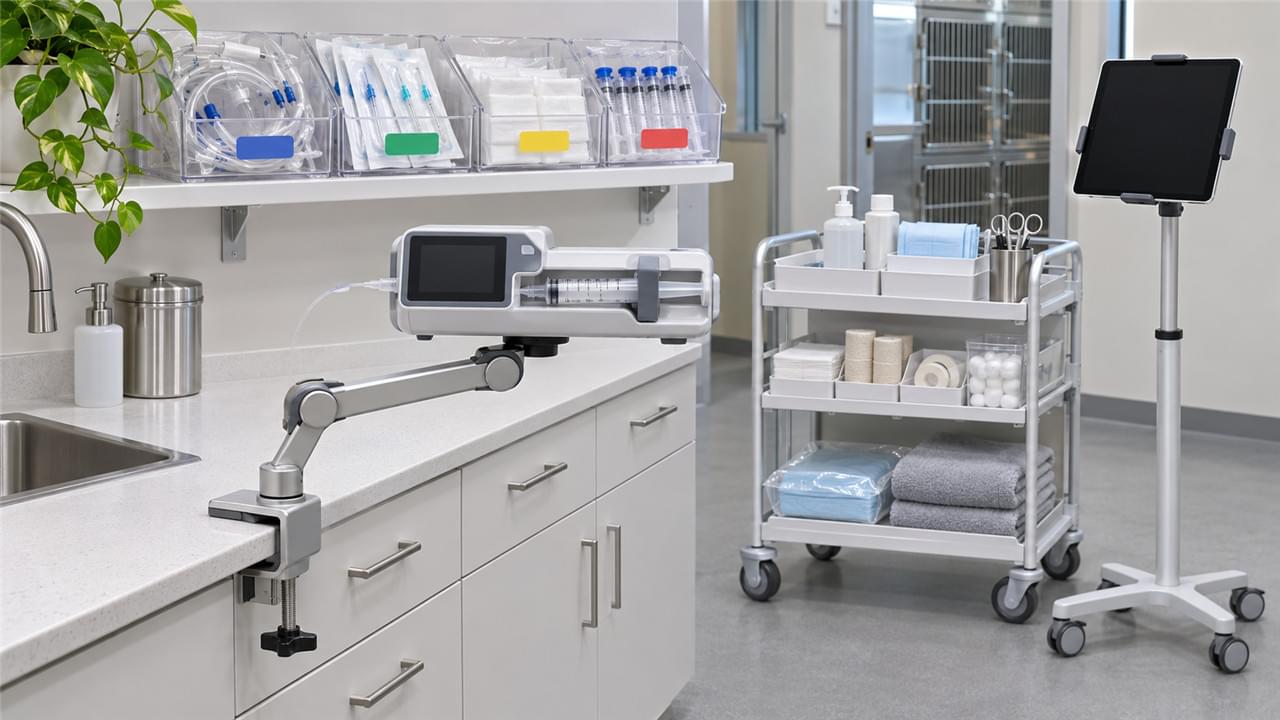
The treatment station is the load-bearing wall of veterinary nursing workflow — the single-point source for all nursing interventions. Co-located there:
- IV catheter set (full size range: 14G–24G)
- IV fluid lines, T-ports, injection caps
- Syringe pump + infusion pump on articulated arm mounts — not on a separate trolley
- Bandaging materials (full roll selection + scissors + tape)
- Wound care supplies (saline flush, dressings, antiseptic)
- Patient documentation access (tablet mount or terminal)
- Sharps disposal container and single-use gloves in multiple sizes
The test is simple: if any routine item forces a nurse to leave the station, the design is suboptimal. A well-stocked station should support 95% of nursing procedures without a single step away. 💪
🛒 Fix 2: Mobile Carts — Equipment Goes to the Patient
🔄 How Mobile Carts Carry Veterinary Nursing Workflow to the Cage
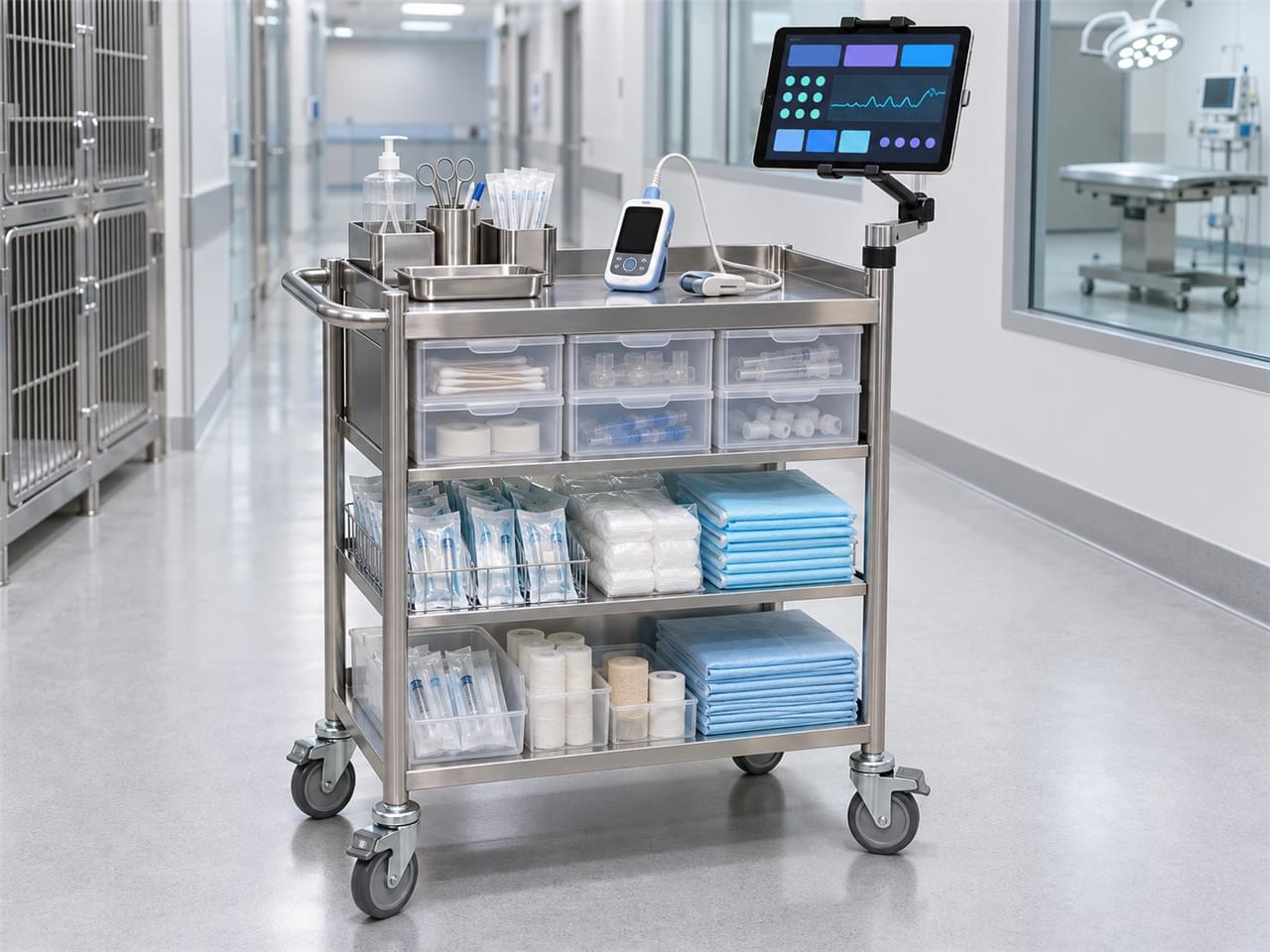
For ward rounds and monitoring, the veterinary nursing workflow depends on equipment that travels to each patient rather than pulling the nurse back to a fixed station. A properly stocked mobile nursing cart carries:
- Handheld pulse oximeter and digital thermometer set
- Handheld Doppler for blood pressure assessment
- Blood glucose meter
- Wound inspection kit (remove bandage, inspect, replace)
- Patient record access via tablet or mobile terminal
- Basic consumables (syringes, needles, gloves, alcohol swabs)
A well-organized mobile ward cart converts a 45-minute nursing round into a 25-minute one — the single best minutes-per-dollar trade in ward design. For the housing these rounds service, see How to Choose Veterinary Cages and Hospital Housing Systems.
💊 Fix 3: Medication Management Proximity
Medication preparation is among the most common bottlenecks in a veterinary nursing workflow. Three solutions:
🧪 Satellite medication station: a ward-side prep area (not the main pharmacy) stocked with the most-used ward medications — IV fluids, maintenance electrolytes, common CRI drugs, pain medications. This cuts trips to the main pharmacy by 50–70% during ward shifts.
💉 Pre-labeled syringe systems: for CRI medications (fentanyl, morphine, dopamine), prepare labeled syringes for the next 12 hours at shift start. Per-dose prep time drops from 5 minutes to 30 seconds.
🧮 Drug calculation aid: a wall-mounted laminated dosing chart or integrated PMS drug calculator eliminates calculation time and reduces dose error risk.
📲 Fix 4: Documentation Integration
📝 Documentation: The Digital Core of Veterinary Nursing Workflow
Paper nursing records are a quiet bottleneck. Every paper record demands physical retrieval from a folder, manual entry at the moment of observation, storage and return, and — where a PMS exists — end-of-shift transcription.
Digital documentation via tablet at the cage side changes the math:
- ✅ Updates the patient record in real time
- ✅ Makes current nursing data visible to clinicians from any workstation
- ✅ Eliminates end-of-shift transcription entirely
- ✅ Triggers automated alerts when recorded values leave protocol parameters
The observation still takes 30 seconds — but it now lives where the clinicians and alerts can act on it. 📊
🛏️ Fix 5: Cage-Side Equipment Placement for ICU Patients
🫀 Cage-Side Equipment Placement That Protects the Veterinary Nursing Workflow
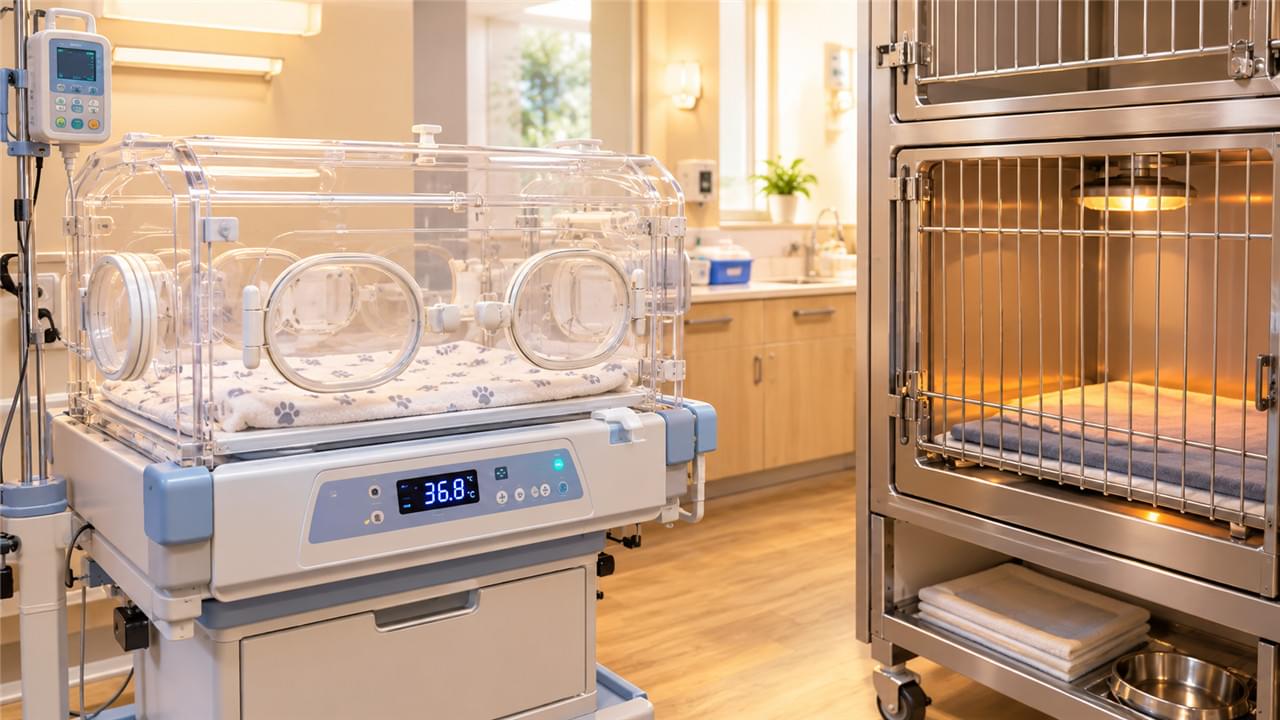
For ICU patients needing frequent monitoring and intervention, cage-side organization is where workflow optimization through nursing equipment design earns its keep. Per cage-side standard:
- IV/syringe pump mounted on the IV stand at cage level
- Patient monitor display at eye level when crouching at the cage front
- Emergency drug calculation card mounted on the cage front
- Small consumable drawer (gloves, tape, 1cc syringes) immediately accessible
Good cage-side equipment placement eliminates every retrieval trip to the treatment station for routine monitoring and medication administration. This is the last mile of the veterinary nursing workflow — the difference between a 4-patient and a 6-patient safe caseload. 🐾
❓ Frequently Asked Questions
Q: How do I calculate how many syringe pumps my ward needs?
A: Count your average concurrent ICU patients and multiply by 1.5 — one pump per IV line plus a 50% buffer for asynchronous pump changes. A 6-bed ICU typically needs 8–10 syringe pumps to maintain continuous CRI medications and keep spares for new admissions. Never run at 100% pump utilization; a single pump failure then creates an immediate patient care gap.
Q: Is a dedicated treatment room better than an open treatment station in the ward?
A: For infection control, a dedicated closed room wins for aerosol-generating or contamination-heavy procedures — dentals, wound flushing, infectious patients. For routine nursing work (IV catheter placement, blood draws, wound checks), an open station inside the ward, visible to the nurse throughout, minimizes patient transport and reduces stress.
Q: What is the single highest-impact veterinary nursing workflow improvement for a new clinic?
A: Mount syringe pumps on articulated arm brackets at the treatment station and at each ICU cage-side IV stand. It ends carrying pumps between locations, removes IV-line trip hazards from the floor, and puts the pump display at eye level for instant rate verification during rounds. At 50–50–150 per bracket, the return is wildly disproportionate. 🏆
🎯 Key Takeaways
A fast veterinary nursing workflow isn’t bought with one big purchase — it’s assembled from five deliberate design moves: a self-sufficient treatment station, a stocked mobile nursing cart, ward-side medication prep, cage-side documentation, and ICU cage-side placement. Fix the layout before you blame the team, and anchor your standards in the WSAVA quality of care guidelines and AVMA practice efficiency resources. Your nurses’ feet will notice first — then your patients’ recovery times. 🐕