Minimally invasive surgery (MIS) has officially shifted from an elite specialty luxury to an absolute mainstream clinical capability. Over the past decade, the rapid evolution of Veterinary MIS trends has transformed how progressive clinics operate and invest in their future. Today, understanding this technological trajectory is essential for forward-thinking clinic owners planning capital upgrades, medical device distributors sourcing equipment packages, and veterinary surgeons looking to elevate their standard of care.
When evaluating these advancements, it is helpful to view them within the broader context of modern Veterinary Surgical Suite Equipment: Systems, Standards & Selection to ensure complete facility integration.
📈 The Shift to Veterinary MIS Trends in Modern Practice
Laparoscopy in the veterinary field first gained meaningful clinical traction in the early 2000s, primarily driven by companion animal practitioners adapting advanced techniques from human medicine. Fast forward to 2026, and these refined methods are standard offerings at regional referral centers and increasingly common in well-equipped general practices.
Three core metrics highlight how Veterinary MIS trends are redefining modern patient care:
- Laparoscopic Ovariectomy: This has rapidly become the elective sterilization method of choice. It offers patients a radically faster recovery time (24 to 48 hours compared to 3 to 7 days for traditional open OHE) while driving exceptional client satisfaction and premium practice revenue.
- Diagnostic Laparoscopy: Targeted liver sampling, biopsies, and abdominal explorations offer high clinical utility with a surprisingly low equipment barrier to entry.
- Laparoscopic-Assisted Procedures: Transitional techniques like gastropexy or intestinal biopsies bridge the gap perfectly, allowing general practitioners to build their MIS capabilities incrementally.
🛠️ Core Procedures & Equipment Demands
To successfully implement these advanced small animal laparoscopic procedures, practices must align their clinical targets with the correct instrumentation. Below is a breakdown of the standard MIS applications dominating the industry today:
| Procedure | MIS Approach | Equipment Required |
| Ovariectomy / OHE | Laparoscopic (1–3 port) | Basic laparoscopy stack |
| Liver & Spleen Biopsy | Laparoscopic | Basic laparoscopy stack |
| Gastropexy | Laparoscopic-assisted | Basic laparoscopy + surgical stapler |
| Cryptorchidectomy | Laparoscopic | Basic laparoscopy stack |
| Thoracic Exploration | Thoracoscopic | Thoracoscopy set + single-lumen DLT |
| Joint Exploration | Arthroscopic | Small-joint arthroscopy set |
| Rhinoscopy / Bronchoscopy | Flexible endoscopy | Flexible endoscope + video processor |
🎛️ Anatomy of a Veterinary Endoscopic Tower Setup
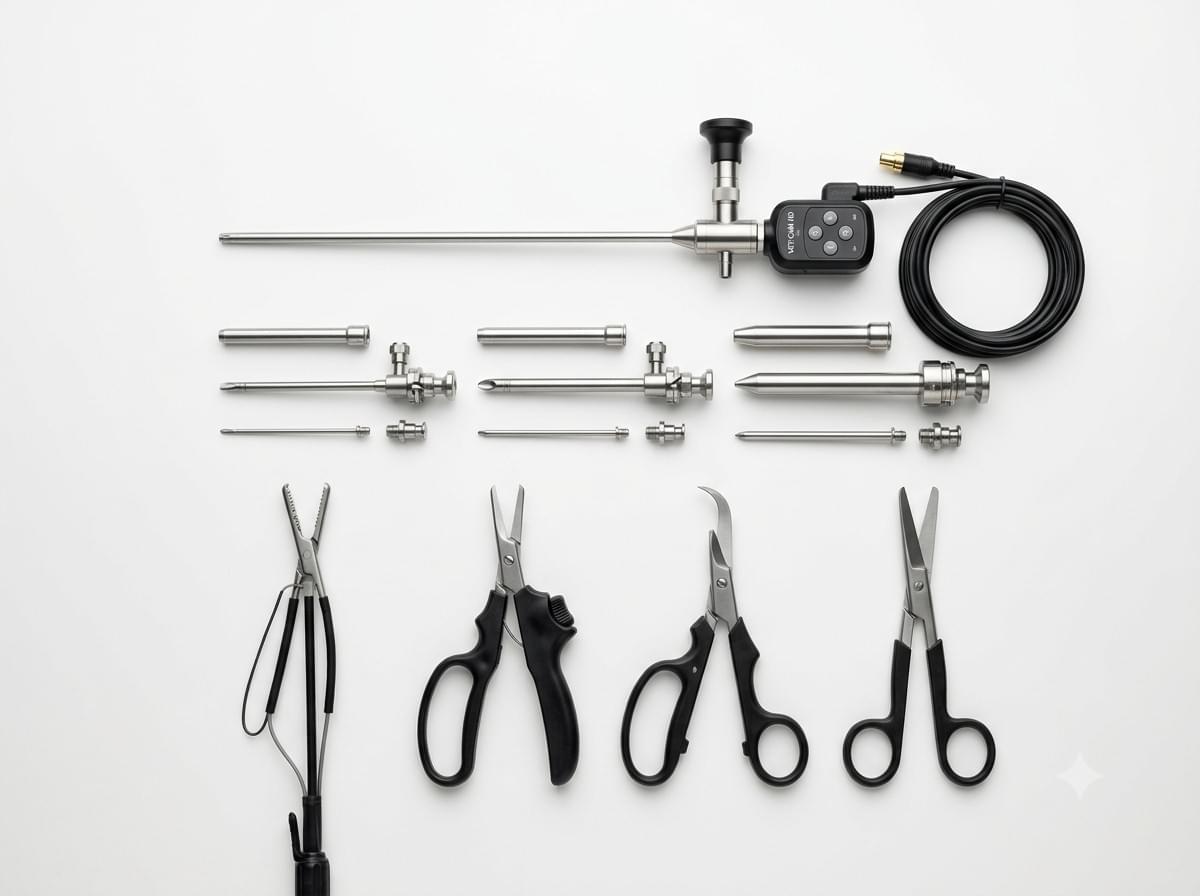
Building a reliable, high-performing veterinary endoscopic tower setup requires a strategic investment in medical-grade hardware. A functional, modern surgical stack consists of seven core components:
1. 📷 HD & 4K Camera Systems
The camera head serves as the surgeon’s eyes. Full HD (1920×1080) resolution is the baseline requirement, though 4K is rapidly becoming the standard at specialty centers. The camera control unit (CCU) must feature intuitive white balancing and reliable digital recording for case documentation and client education.
2. 💡 High-Efficiency LED Light Sources
Modern veterinary settings have phased out older, high-heat xenon bulbs. Adjustable, high-intensity LED light sources (minimum 150W) are the modern choice because they deliver cool, daylight-quality illumination, lower operating temperatures, and an exceptionally long operational lifespan.
3. 💨 Smart CO₂ Insufflators
An electronically controlled CO₂ insufflator with real-time pressure and flow displays is absolutely critical for patient safety. The system must feature an automatic cutoff when intraabdominal pressure reaches preset limits—typically 8–12 mmHg for canine patients and significantly lower for felines.
4. 🔬 Rigid Endoscopes
A versatile inventory requires premium 5mm or 10mm diameter rigid scopes with a 33cm working length. While a 0° scope offers a direct view, a 30° viewing angle telescope is highly recommended as the foundational tool for complex abdominal visualization.
5. 🛠️ Trocars & Cannula Sets
Reusable 5mm and 10mm trocars equipped with bladeless or conical tips offer long-term cost efficiency. However, premium disposable trocars remain a highly acceptable alternative for lower-volume practices prioritizing immediate convenience.
6. ✂️ Specialized Hand Instrumentation
Your surgical tray should include premium Maryland dissecting forceps, atraumatic grasper variants, laparoscopic scissors, and ergonomic needle drivers. Integrating an advanced vessel-sealing device compatible with laparoscopic ports is highly recommended to minimize surgical time.
7. 🖥️ Medical-Grade Monitors
Surgeons require a minimum 24-inch flat-panel medical monitor featuring an anti-glare coating and a wide viewing angle. This ensures the entire surgical team can monitor the procedural field clearly without color distortion.
🚀 Future Outlook: Emerging Veterinary MIS Trends
Looking ahead, the market is moving toward highly specialized equipment. Staying ahead of these Veterinary MIS trends allows practices to differentiate themselves in a competitive veterinary market.
🧬 Single-Port Laparoscopy (SILS)
Single-incision laparoscopic surgery via a solitary transumbilical portal is gaining significant traction for routine canine sterilizations. SILS drastically minimizes port-site morbidity and provides superior cosmetic outcomes. However, it does require specialized multi-channel ports and articulating hand instruments.
🖥️ Next-Generation 4K Ultra-HD Visualization
The industry is pivoting hard toward 4K ultra-high-definition imaging systems. This massive resolution boost provides unmatched visual clarity during delicate tissue dissection near critical vascular structures, acting as an invaluable asset for training environments.
🤖 Robot-Assisted Surgical Integration
While scaled-down robotic surgical systems are currently undergoing rigorous evaluation at major university teaching hospitals, wide-scale commercial adoption in private general practice remains limited by high acquisition costs. Nonetheless, the technology path mirrors human medicine quite closely.
🔄 Multi-Platform Flexible Endoscopy Integration
Modern veterinary practices are actively integrating flexible endoscopy—such as bronchoscopy and gastrointestinal tracking—directly into their primary MIS suites. Utilizing unified video processors that support both rigid and flexible scopes drastically reduces total capital expenditure.
💰 Smart Capital Investment & Veterinary MIS Trends
Navigating the true veterinary laparoscopy equipment cost requires balancing immediate procedural demand against future expansion. Practices looking to align with current Veterinary MIS trends should divide their procurement roadmap into clear phases:
- Immediate Procurement (High ROI): Prioritize a complete foundational laparoscopy tower setup (HD camera, smart LED light source, CO₂ insufflator, and essential 5mm instrumentation). Total investments typically range from 18,000-45,000 depending on configuration. Adding a dedicated vessel-sealing unit (3,000-8,000) will immediately optimize surgical efficiency.
- The 2-to-3-Year Upgrade Path: Plan for an upgrade to a 4K camera head unit and expand your tooling to include dedicated small-joint arthroscopy sets.
- Long-Term Evaluation: Monitor the cost trajectory of robotic assistance platforms and specialized single-port access tools until they match your regional caseload.
To ensure your investment remains viable over time, strict compliance with Sterilization & Infection Control in Veterinary Surgical Suites is mandatory to protect sensitive optical components.
❓ Frequently Asked Questions
Q: Do general practitioners need specialized training to offer laparoscopy?
A: Absolutely. Laparoscopic surgery demands a unique visual-motor skill set that differs significantly from traditional open techniques. Organizations like the Association of Veterinary Soft Tissue Surgeons (AVSTS) and major university veterinary teaching hospitals regularly host structured wet labs and simulator training courses. Most practitioners comfortably achieve independent competency in standard laparoscopic ovariectomies after attending a structured course and completing supervised procedural days. For general industry standards, consult the official AVMA veterinary surgical standards.
Q: What caseload justifies investing in advanced small animal laparoscopic procedures?
A: As a reliable benchmark, if a general practice averages five or more elective sterilizations per week, a foundational laparoscopy tower setup typically achieves a complete return on investment (ROI) within 18 to 30 months. This is accomplished by applying a standard procedural premium (150-400 over an open spay, depending on local demographics) and leveraging the immense marketing value of offering true minimally invasive care.
Q: Can I use refurbished human laparoscopy equipment in my veterinary practice?
A: Only partially. While many high-quality rigid endoscopes, trocars, and manual hand instruments are mechanically compatible between human and veterinary applications, camera connections and light guides often feature distinct proprietary fittings. Additionally, pediatric human instruments do not always align perfectly with the precise working lengths required for very small canine or feline patients. Always verify connection standards and component compatibility before purchasing cross-market gear. For international clinical alignment, review the comprehensive WSAVA minimally invasive surgery guidelines.