Companion animals are living longer than ever, and the veterinary caseload of senior and mobility-impaired patients is growing just as fast. Rehabilitation aids are the equipment that bridges the gap between a diagnosis and a decent life — compensating for functional deficits, protecting quality of life, and slowing the progression of degenerative conditions.
This guide walks through the five equipment categories every practice should know when supporting senior and mobility-impaired patients. For the broader context, see the Veterinary Rehabilitation & Physiotherapy Equipment Guide.
🩺 Who Are Mobility-Impaired Veterinary Patients?
Mobility impairment spans a wide clinical spectrum, and matching rehabilitation aids to the right condition is half the job:
- Osteoarthritis — the most prevalent condition, affecting an estimated 40%+ of dogs and 35%+ of cats over age 8
- Intervertebral disc disease (IVDD) — spinal cord compression causing paresis or plegia
- Degenerative myelopathy — progressive neurological decline in predisposed breeds
- Neurological injury / FCE — sudden-onset paresis from fibrocartilaginous embolism
- Orthopedic injuries — fracture sequelae, hip dysplasia, ligament injury
- Post-surgical or post-trauma patients with residual gait deficits
Each condition calls for a different combination of support aids, therapeutic modalities, and exercise equipment.
🛞 Category 1: Mobility Carts and Wheeled Supports
🦮 Rehabilitation Aids for Hindlimb Support: Rear-Wheel Carts
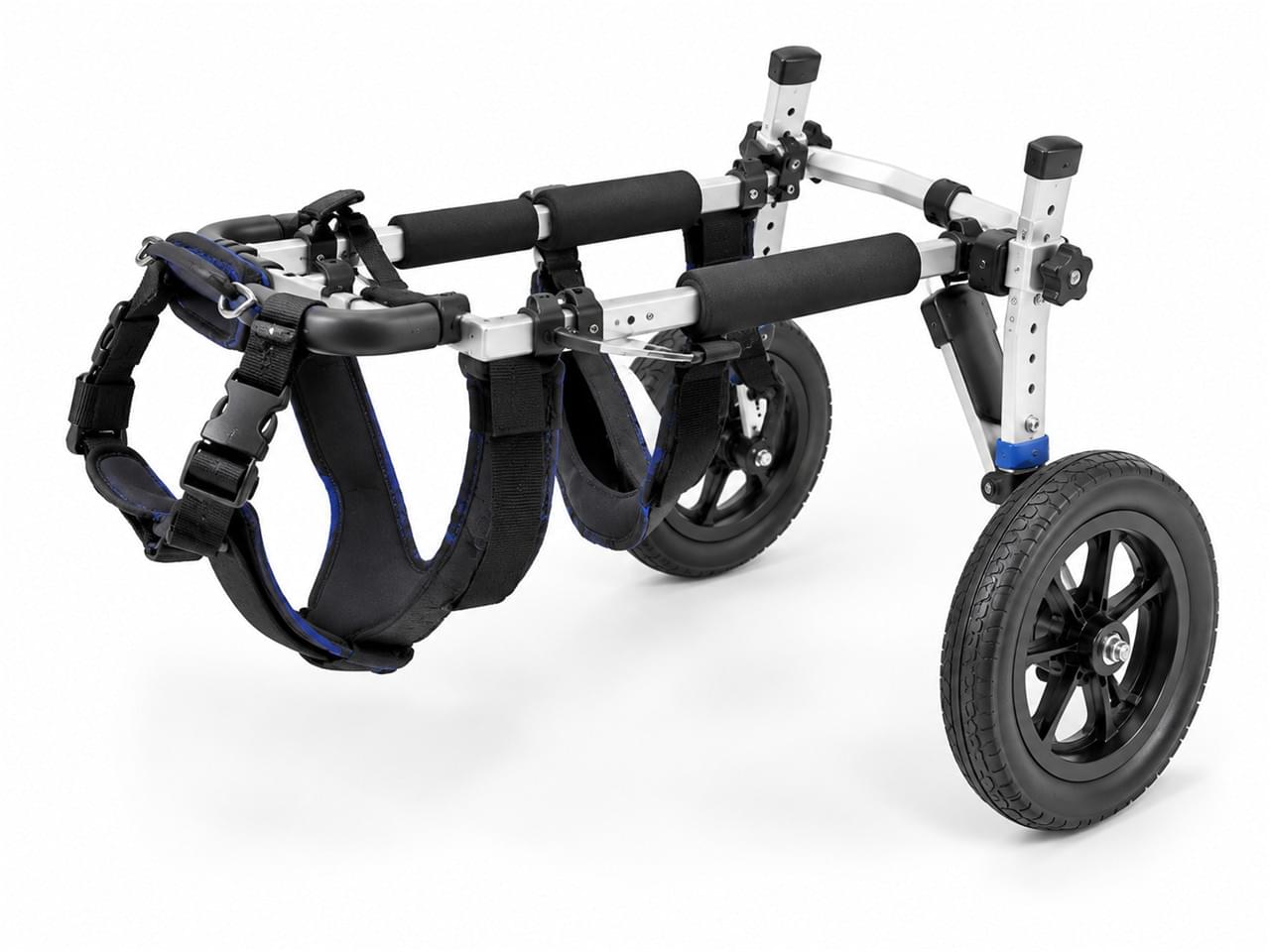
Rear-wheel mobility carts for dogs are the most commonly needed device for paraplegic and severely ataxic hindlimb patients:
- They support the hindquarters while the patient keeps moving on its forefeet
- Patient-specific fitting is essential — the cart must match the individual’s thorax dimensions, hindlimb length, and weight
- Lightweight aluminum frames with neoprene padded slings provide perineal support without pressure points
- Daily use is realistic; many patients master cart mobility within 1–2 weeks
Front-wheel configurations are less common but essential for tetraparesis, radial nerve paralysis, severe cervical myelopathy, or forelimb amputation recovery. Compared with rear-wheel mobility carts for dogs, front-wheel units demand more careful balance tuning — the patient’s remaining propulsion comes entirely from the hindquarters — so reserve them for cases that truly need them.
🔧 Cart Fitting Is a Service, Not Just a Sale
A poorly fitted cart causes pressure sores, perineal irritation, and secondary skin complications — sometimes worse than the original problem. Many rehabilitation practices run dedicated cart fitting appointments as a specialist service, and it’s worth every minute.
🦴 Category 2: Orthotic and Prosthetic Devices
📐 Orthotics: Rehabilitation Aids That Realign and Protect
Custom orthotic braces — 3D-printed or custom-fabricated — maintain joint alignment, prevent excessive range of motion, and provide proprioceptive feedback:
- Tarsal (ankle) orthotics for chronic tarsal hyperextension after peripheral nerve injury
- Carpal orthotics for hyperextension injuries and ligament insufficiency
- Stifle orthotics for medial support in partial cruciate instability when surgery isn’t an option
🦿 Veterinary Prosthetics
Custom prosthetic limbs from specialist veterinary companies give amputee patients a second chance at functional ambulation — increasingly viable as fabrication technology improves.
🤝 Category 3: Support Harnesses and Lifting Aids
Of all the rehabilitation aids in this guide, harnesses are the ones owners interact with daily — and the cheapest recommendation you’ll make all week.
🎽 Support Harnesses: Everyday Rehabilitation Aids at Home
Support harnesses for senior dogs let owners assist hindlimb patients without a cart:
- Neoprene or webbing sling designs support the perineal region
- Adjustable for body weight and limb positioning
- Essential between rehabilitation sessions and for outdoor toilet support
Full-body support harnesses for senior dogs with cervical myelopathy, tetraparesis, or general weakness add forequarter assistance. For large breeds, body lift harnesses with handle systems make stairs and vehicle transfers safe for everyone — and transfer boards help move non-ambulatory patients without straining anyone’s back.
🏠 Category 4: Environmental Modification Equipment
Mobility-impaired patients live in houses built for able-bodied ones. Fixing that is cheap and transformative.
🧱 Environmental Rehabilitation Aids: Flooring, Ramps, and Bedding
Non-slip solutions:
- Rubber matting — the single most cost-effective mobility improvement for arthritic dogs
- Paw grip socks for hardwood and tile floors
- Runner mats along frequently traveled routes
Ramps and steps:
- Vehicle access ramps with adjustable height and non-slip surfaces
- Furniture ramps so arthritic patients can still reach the bed or sofa for bonding time
- Stair ramps to replace step-over barriers
Orthopedic bedding:
- Memory foam beds reduce pressure points in recumbent patients
- Heated beds add thermal comfort for arthritic joints
- Waterproof covers are non-negotiable for incontinent patients
⚡ Category 5: Therapeutic Modalities for Senior Patients
The best physical rehabilitation aids manage the pain that makes movement worth avoiding in the first place. Senior patients benefit from every standard modality, scaled to their tolerance:
- Laser therapy — the most evidence-supported medical modality for canine osteoarthritis pain
- TENS — non-invasive home pain relief with owner-administered units
- PEMF — wearable pads for degenerative myelopathy and arthritis management
- Underwater treadmill — removes joint load while keeping muscle conditioning, ideal for obese arthritic patients
❓ Frequently Asked Questions
🗓️ When Should Rehabilitation Aids Be Introduced for Senior Pets?
Early — at the first signs of reduced activity, stiffness, or reluctance to climb stairs. Waiting for severe impairment means managing advanced disease with a limited prognosis. For predisposed breeds (Labrador, German Shepherd, Dachshund, Maine Coon), a baseline assessment at age 6–7 catches decline early, when rehabilitation aids for senior and mobility-impaired animals do the most good.
📏 How Do I Choose the Right Mobility Cart for a Dog?
Measure before ordering: thoracic girth, body length from shoulder to hip, hindlimb length (ground to stifle), and weight. Most manufacturers offer fitting templates and consultation services. Better still, use demonstration carts for fitting trials or a trial rental period before committing to a custom unit — no one wants an $800 lesson in sizing.
🐈 Can Cats Use Mobility Carts?
Yes — with species-specific design: lighter frames, different body proportions, and vertical perineal access for toileting. Feline carts are increasingly used for spinal cord injury, pelvic fractures with nerve damage, and degenerative neurological conditions.
🎯 Key Takeaways
The best rehabilitation aids don’t replace veterinary medicine — they extend it into the patient’s daily life. Carts restore movement, orthotics protect joints, harnesses keep owners involved, home modifications prevent injury, and therapeutic modalities manage pain underneath it all. Plan the full environment, not just the device, and anchor welfare decisions in the WSAVA senior animal welfare guidelines and AVMA animal welfare and rehabilitation standards. For clinic-side layout and equipment placement, see Setting Up a Veterinary Rehabilitation Room. 🐾